The IT Infrastructure Library (ITIL) is the de-facto standard around the world as a guide for IT professionals to manage IT services. It is designed to be customer focused, quality driven, and economical. It evolved from a standard defined in Great Britain by their Central Computing and Telecommunications Agency (CCTA) back in the 80’s. The British government needed a unified standard to improve the quality of IT services they had received. The result was this compilation of best practices, and it’s being used by other IT organizations around the world.
After several iterations, the ITIL standard is now on version 4, published in February 2019. The key components of ITIL 4 are the four dimensions model of service agreement, and the ITIL Service Value System (SVS), illustrated in the diagram below:
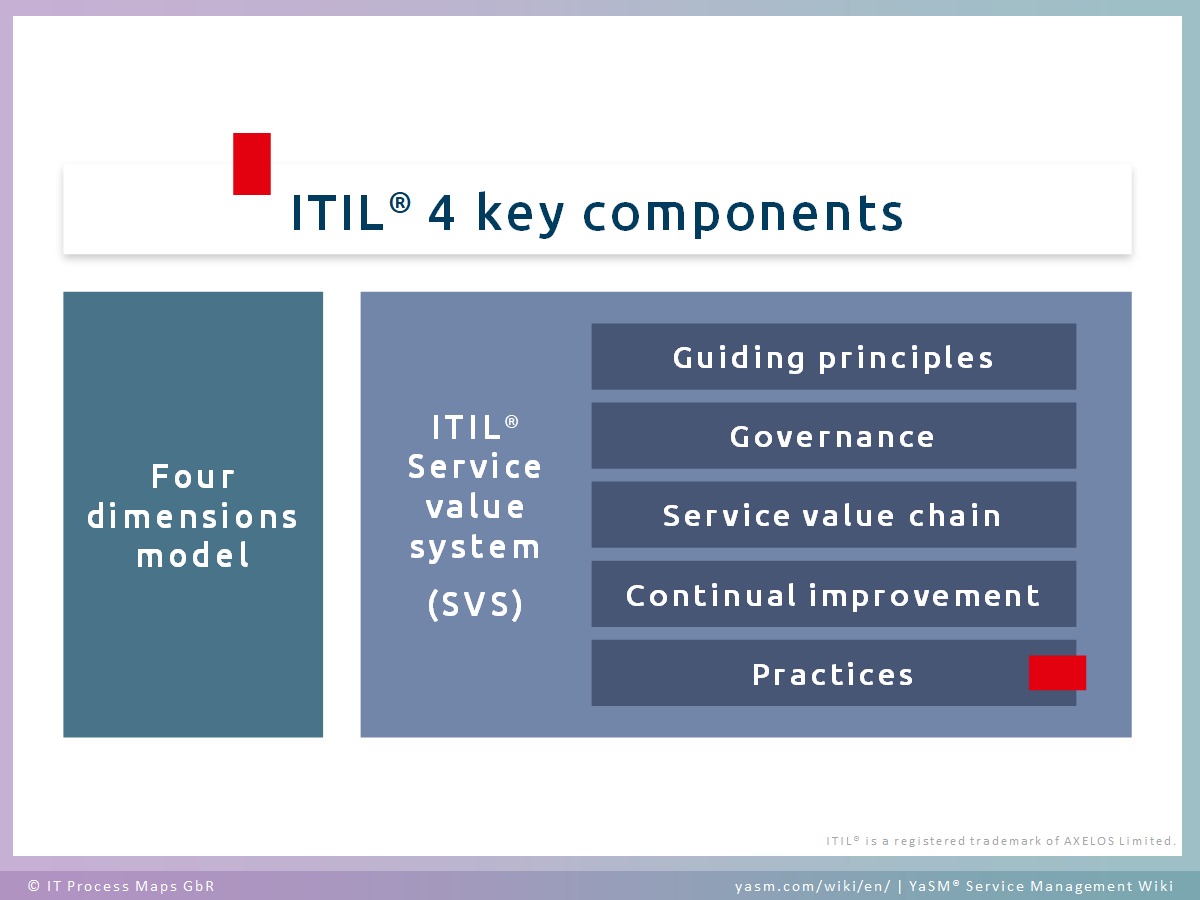
The four dimensions model are:
- Organizations and People
- Information and Technology
- Partners and Suppliers
- Value Streams and Processes
More detailed explanation of the model and components are in the YASM Wiki site.
For IT System Administrators and Managers, ITIL 4 framework has a focus on overseeing the infrastructure and platforms used by organization that enables monitoring of available technology solutions. It includes a model to manage vendors providing Software as a Service (SaaS) and cloud computing environments, as a way of flexible and on-demand expansion. It outlines requirements for configurable computing resources and network access.
The framework of ITIL 4 for IT infrastructure and platform management, stem from the following:
- IT Infrastructure components such as physical (ie. Dell, HP, Sparc servers), or virtual (ie. VMWare, Citrix, AWS), including the technologies used behind-the-scene, such as storage, network, Middleware applications (ie. JBOSS, Elasticsearch), and Operating Systems (ie. Linux, Windows).
- Develop an implementation and administration strategy for infrastructure or platform that is unique for the organization, to fulfill the business and technical requirements.
- Design communication methods between the organization’s own systems (cloud or on-premise), as well as to vendors in a secure and efficient way.
Of course, the above key concepts are an over simplification of the actual implementation. Running a data center is difficult and can be costly. Software is not perfect and fails without proper maintenance. Cybersecurity is complex, both in social and technological contexts. Technology keeps changing that will require constant training of the IT staff to keep up to date.
These are some of the reason why guidelines like ITIL 4 is valuable for IT Managers and Directors to be familiar with. It serves as a starting point to build IT infrastructure and platforms. They need to apply the practice on their own organization. With proper investment, going through many deployment iterations and lessons learned, an organization will be able to achieve the desired stability and security required.
To see how the four dimensions work together, imagine a company launching a new Online Food Delivery App. To make the service successful, the company must plan and manage all four dimensions simultaneously:
👥 1. Organizations and People- The Team: Customer support agents, software developers, and delivery drivers.The Culture: A focus on speed and empathy, where support agents are empowered to instantly refund a customer if an order is wrong.The Skills: Drivers need GPS navigation training, and developers must know how to code secure payment systems.
💻 2. Information and Technology- The Technology: The mobile app itself, cloud servers to host it, and AI algorithms to predict delivery times.The Information: Customer address data, credit card tokens, restaurant menus, and real-time driver locations.Security: Encryption systems to ensure customer data and passwords remain safe from hackers.
🤝 3. Partners and Suppliers – The Restaurants: External partners who prepare the food.The Cloud Provider: A vendor (like AWS or Microsoft Azure) hosting the app’s infrastructure.The Payment Gateway: A third-party service (like Stripe or PayPal) processing the transactions.The Map Provider: Google Maps API utilized to show drivers where to go.
⚙️ 4. Value Streams and Processes – The Value Stream: The entire journey from a hungry user opening the app, to the restaurant cooking, to the driver dropping off the food.The Processes: Specific, repeatable steps for handling routine events, such as:How a driver checks in at a restaurant.How the system automatically refunds a user if food arrives cold.
⚠️ What happens if one is missing?If the app has great technology (Dimension 2), strong restaurant partners (Dimension 3), and efficient workflows (Dimension 4), but the customer service agents are untrained and rude (Dimension 1), the service will still fail because customers will abandon the app.
ITIL must have the benefits to become successful:
– Value must be co-created, where both sides benefit from the best practices.
– Outputs/Outcomes: The output has to meet the needs of the customers.
– Utility/Warranty: Dependability is key
Service: the co-creation of value by facilitating outcomes customers want, without them having to manage the costs and risks.
Examples:
– Service offerings: Exchange of goods, Access to Resources, and Delivery of Service Action
– Service Management: set of specialized organizational capabilities that enable value for customers in the form of services
– Service Relationship: the cooperation that results between a service provider and service consumer
Service Value System consists of principles, governance, practices, service value chain, improvement
– Guiding principles: Recommendations for effectively delivering IT Services
– Governance: Rules for how IT is implemented
– SVC (Service Value Chain): a set of activites that work together to produce value with IT
– Practices: things we do and tools we use to provide value in IT
– Continual improvement: Execute, learn, and improve with each iteration
7 Service Value Chain activities:
1. Plan
2. Improvement
3. Design and Transition
4. Engage
5. Obtain and Build
6. Deliver and Support
7. Products and Services
Service Value System (7 guiding principles)
1. Focus on Value
2. Start Where You are
3. Progress Iteratively
4. Collaborate
5. Think and work holistically (step out of comfort zone, understand big picture)
6. Keep it Simple
7. Optimize and Automate